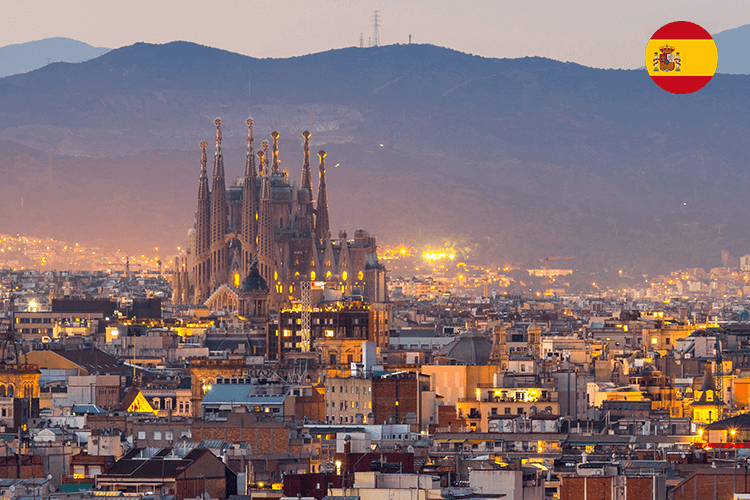
Spain, officially a parliamentary monarchy and a member of the European Union, features a highly vibrant constitutional democracy with a population of approximately 48 million people. Economically, the country relies heavily on services, tourism, and manufacturing, maintaining a developed economy that has shown resilience despite historical fiscal challenges. Politically, Spain operates under a competitive multiparty system with a decentralized structure that gives significant autonomy to its diverse regional autonomous communities, such as Catalonia and the Basque Country. This distinct blend of a strong national identity alongside fierce regional pluralism deeply shapes Spain’s cultural fabric, establishing a society where regional languages, distinct traditions, and localized political debates are just as prominent as national affairs.
When analyzing Spain’s media landscape through mass communication theory, the Social Responsibility model applies most accurately. Unlike a pure Libertarian model that relies entirely on unregulated corporate markets, Spain enforces an ecosystem where the media is expected to fulfill distinct obligations to the public. This is visible in the prominent role of public service broadcasting, specifically via Radiotelevisión Española (RTVE), which is funded through the state to provide educational, cultural, and balanced programming rather than focusing solely on commercial ratings. According to the Freedom House 2026 report, Spain maintains an exceptional Global Freedom Score of 91 out of 100, certifying it as a free nation where civil liberties are well protected. However, Reporters Without Borders notes that while the legal framework is solid, political polarization has put pressure on journalists, mirroring the exact kinds of societal fractures discussed in the reading “Are Social Media Driving Political Polarization?”
The individual sectors of Spanish media reveal fascinating structural parallels and contrasts when compared to the United States. In the television and radio sectors, Spain features a hybrid model where public networks compete directly with large commercial conglomerates like Atresmedia and Mediaset España. In contrast, the United States relies almost entirely on commercial broadcast networks, where public broadcasting like PBS receives minimal state support and holds a much smaller market share. For the print sector, Spanish newspapers like El País and El Mundo are traditionally tied to specific ideological and political leanings, a dynamic that differs from the historic American journalistic norm of striving for objective, non-partisan reporting. In terms of cinema, Spain’s film industry is heavily supported by government subsidies and European cultural grants, protecting local artistic expression from being completely swallowed by Hollywood commercialism. Digitization has completely transformed both nations, yet Spain maintains high internet freedom. Spain does not have a direct equivalent to Section 230, as it operates under European Union digital services regulations that place stricter compliance rules on tech platforms regarding data privacy and hate speech.

A major point of regulatory divergence between the two nations involves the boundaries of protected expression. While the United States relies on the near-absolute protection of the First Amendment, Spain features laws that restrict certain types of speech, such as insults to the crown or state institutions. Furthermore, Spain’s controversial Citizen Security Law, commonly referred to as the Gag Law, has drawn sharp criticism from human rights groups for imposing fines on journalists who photograph law enforcement officers during public protests. This stands in stark contrast to the United States legal framework, where recording police in public spaces is a widely protected constitutional right. This means that while Spanish citizens enjoy a robust public sphere, they face a higher degree of statutory legal risk when challenging state authority directly.
In conclusion, both the Spanish and American media models offer distinct advantages and flaws regarding the public interest. The advantage of the Spanish system is its commitment to public service media, ensuring that cultural programming and local news are accessible without being entirely dictated by corporate advertisers. This avoids the severe corporate capture and news suppression exposed in the film Shadows of Liberty. However, the con of the Spanish system is its vulnerability to political polarization and state regulatory overreach through laws like the Gag Law. Meanwhile, the United States benefits from immense structural independence from government censorship, but its extreme commercialism leaves the public square vulnerable to the corporate manipulation described in the text “We Need a Media System That Serves People’s Needs, Not Corporations’.” Ultimately, while the United States struggles with a system where corporate profits dictate the news, Spain faces the ongoing challenge of preventing political actors from compromising its media independence.
Leave a Reply